Balancing Profits and Purpose: Nurturing a More Human Economy
At the Pontifical Academy of Sciences

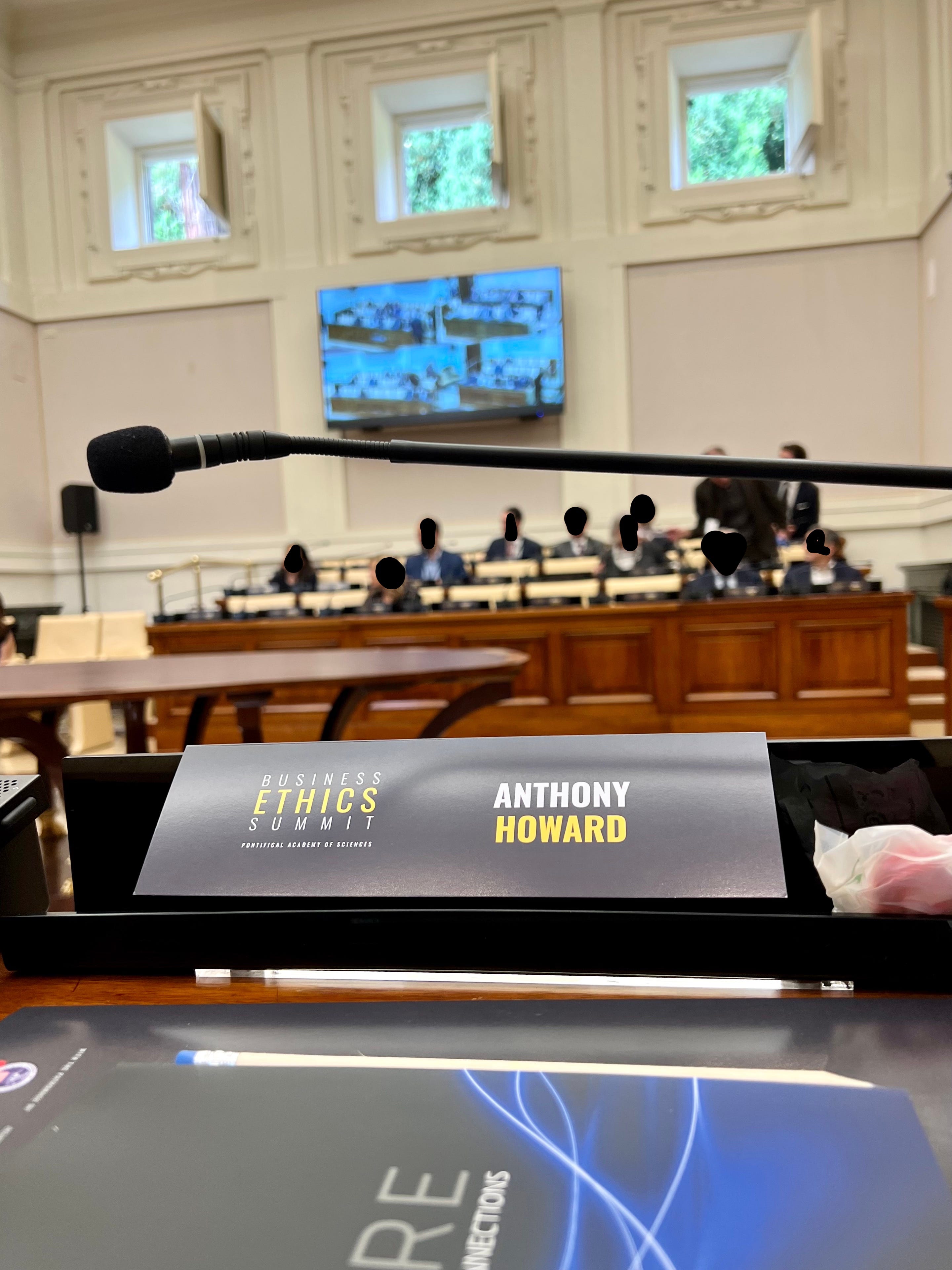
Last week I had the privilege of attending a Business Ethics Summit at the Pontifical Academy of Sciences, in Vatican City. Organised in collaboration with Father Philip Larrey, Dean of the Philosophy Department at the Pontifical Lateran University, the Summit convened a range of high profile international contributors including CEOs, Vatican representatives, and academics. Together we explored the application of ethical and moral principles in the corporate landscape. As both an Adjunct Associate Professor at the University of Notre Dame in Australia, and the CEO and founder of two companies focused on CEO mentoring, leadership development, and the transition to a society grounded in higher order values, the Summit aligned perfectly with my expertise and interests.
To spend the day in the hallowed halls of the Pontifical Academy of Sciences, with its rich history dating back to the 1600s, was a highlight of my professional life.
During the Summit we examined the economy from four perspectives: the person, technology, impact, and the environment. Each perspective was considered through the philosophical lens of a selected philosopher: John Stuart Mill, Immanuel Kant, Aristotle, and Confucius respectively.
Balancing ethics and the economy
In this setting I contributed my thoughts in a session on the human economy: the challenge of balancing growth and prosperity, across the economy and environment, and doing so in an ethically acceptable manner.
I argue we are living in a moment of profound transition. The relentless pursuit of scientific reductionism, which seeks to measure everything and everyone, falls short when faced with intangible mysteries that lie beyond its grasp. People are increasingly searching for meaning in the realm of the esoteric and the spiritual. This unique moment is not one for pessimism or blind optimism, but rather for thoughtful choices that possess the potential to shape not only the next generation, but several generations beyond ourselves.
Building on this context, I offer three key observations, which provide a means of integrating people and the economy, and placing profit in service of persons:
First, we must always remember that the economic question is multifaceted, encompassing both objective and subjective dimensions. This challenges us to integrate the objective economic value of work and production, with the subjective ethical value that nurtures workers and contributes to their human flourishing. The notion of ‘human-centred’ and ‘human-centricity’ has gained prominence in recent years, particularly in the design and leadership domains. My book, Why Human-centred leadership is the key to the 21st century, explored this in more depth. The growing quest for meaning has prompted people to leave stable jobs in search of deeper purpose. Despite persistent, and growing, economic pressures, people are increasingly opting for lives characterised by virtue and personal transformation, aligning their actions with the pursuit of higher order values.
Second, viewing business, government and civil society through the lens of the human person enables us to reconcile the tension between radical autonomous individualism and collective totalitarianism. Radical individualism places the individual at the centre, elevating personal feelings to the sole determinant of decision-making. On the other hand, collectivism treats the individual as a mere instrument of economic production, a resource to be used and discarded when no longer fit for purpose.
It is crucial to recognise that these tensions do not merely divide nations, or align with left or right political ideologies. They exist within society and within the realm of business itself. Business, driven by collective interests of shareholders, aims to maximise profit and will utilise ‘human resources’ to do so. At the same time, individuals, motivated by self-centred desires, can use business to seek personal advancement and financial gain. Rather than succumbing to a binary, either-or dichotomy, the solution lies in adopting a truly human perspective that places human flourishing at the core of decision-making.
By doing so we force ourselves to consider the impact of our decisions on colleagues, communities, nations, and the planet. This holistic approach to decision-making leads to better outcomes and fosters the well-being of all, rather than prioritising utilitarian notions of the greatest good for the greatest number.
Third, it is imperative to integrate economic and ethical value within our business practices. While economic value is essential for any enterprise—to ensure fair pay for workers, and reasonable terms with suppliers—we must delve deeper into ethical questions. What constitutes sufficient profit? How can we foster human flourishing and promote the dignity of every person? Such ethical considerations weave a fabric for economic action, and can guide us toward a more just business environment.
Practical action
In light of these observations, I propose two milestones that would indicate we are making progress toward a more human economy:
First, let us accept and embrace the wisdom of philosophers and ethicists, and appoint at least one to each Board. Philosophers bring deep insight and understanding of meaning, purpose and human dignity. Incorporating their perspective will bring nuanced ethical thinking to decision-making, in the context of good governance and economic performance.
Second, let us implement a Persons Impact Audit, akin to an Environmental Impact Study, to evaluate the consequences of our strategies and operations on people and their flourishing. The PIA should consider the long term impacts across seven generations, taking into account the wellbeing and dignity of of persons. Such a rigorous evaluation would identify potential pitfalls, minimis harmful practices, and align actions with the promotion of human flourishing.
The combination of these two actions will help restore balance between dollars and dignity, and remind us not to use people as a means to an end, but as persons worthy of care and respect. It will challenge us to rise above the relentless pursuit of profit at any cost, fostering a more compassionate and merciful business environment.
Ultimately, business goes beyond an economic pursuit. It is a place where people invest years of their life, a place that shapes their identities and their future. It can be a a place for nurturing growth and development, in which people are genuinely cared for, or it can be a place marked by exploitation and abuse. By placing philosophy and ethics at the centre of our decision-making, we have the power to transform even the most profit-oriented enterprises into beacons of compassion and humanity.
Business has immense potential to create positive change and elevate the well-being of all stakeholders. By embracing a deeply personalist approach, where ethical values are as integral as economic considerations, we can cultivate a more harmonious and inclusive economy: fostering prosperity while upholding the dignity and flourishing of every person involved. Doing so will be truly transformative, reshaping the world of business, and leaving a legacy of compassion, wisdom, and shared prosperity for all, for generations to come.
I love the idea, but find myself struggling at the conjunction of philosophy, ethics and capitalism. Whilst return on capital exceeds return on labour (Picketty) the asymmetry that is at the heart of current issues remains. Philosophy and ethics have longer term perspectives than the current practice of shareholder capitalism. Can that circle be squared?